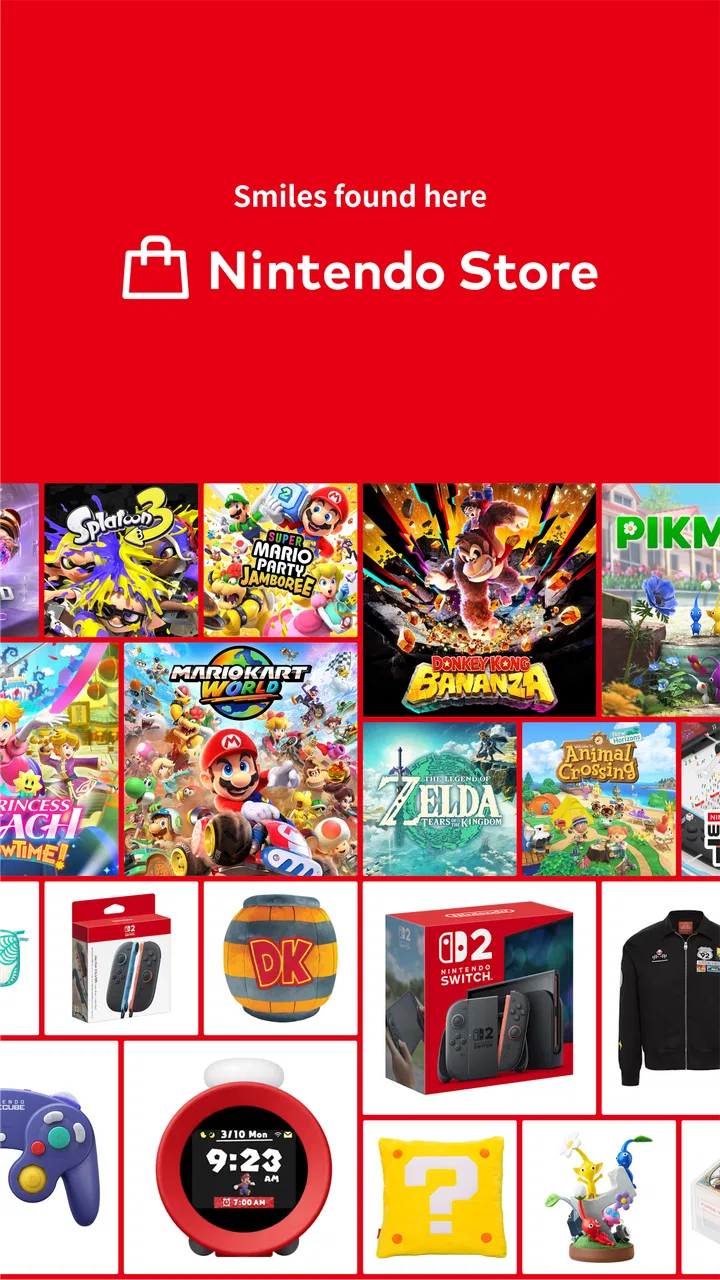
Nintendo Store
- 4.0
- Rating
- 1.00M
- Installs
- Free
- Price

 Analysis by App-foxy
I approached Nintendo Store as a shopping app rather than as another place to browse game news. That distinction matters. Its simple store summary, “Smiles found here,” sets a friendly tone, while the short description identifies it plainly as Nintendo Store. In everyday use, I found the app most interesting when I wanted a more focused way to explore Nintendo products instead of moving through a broad marketplace filled with unrelated brands.
Developed by Nintendo Co., Ltd., this free shopping app sits in a useful middle ground: it is more direct than a general retailer, but it is not something I would install expecting a complete entertainment hub. Its main value is the focused shopping experience. If you already know that your next purchase will be connected to Nintendo, reducing the distance between curiosity and product discovery can make the process feel much less cluttered.
Focused shopping is the capability that shapes the whole experience
The strongest capability here is focused Nintendo shopping. Instead of asking a general marketplace to understand why a Nintendo item matters to you, the app keeps the subject narrow. That focus changes how I browse. I am not constantly filtering out unrelated accessories, competing platforms, or products that happen to share a search term. The app’s identity is clear from the moment it opens: this is a dedicated place for Nintendo Store browsing.
You May Also Like

 Blood Strike: 2.5 Anniversary
Blood Strike’s Loadouts Turn Every Drop Into a Tactical Gamble
A close look at Blood Strike’s custom loadouts: how fast access to signature weapons reshapes its battle royale rhythm, rewards preparation, and narrows the gap between fights.

 Pandora - Music & Podcasts
Pandora’s Music Is Easy to Start, but Harder to Recover
Pandora’s strength is its low-effort path from a seed to a station. Its weak spot is how much confidence it asks you to place in connection, setup, and quiet recovery.

 8 Ball Pool
 Is Built on Rivalries, Rematches, and Routine
A close look at the rivalries, rematches, shared routines, and unanswered safety questions that turn a quick pool match into a persistent mobile community.

 Samsung Music
’s Quiet Strength Is Playing What You Already Own
Its reach comes less from spectacle than from dependable access to a personal library. That simplicity is both the app’s strongest retention engine and its ceiling.

 AccuWeather: Weather Radar
AccuWeather Review: A Quick, Clear Forecast for Everyday Decisions
For everyday plans, the best forecast is the one you can understand quickly. AccuWeather makes rain timing, radar, and local conditions easy to act on, with a few trade-offs.

 Hill Climb Racing
Why Hill Climb Racing Still Turns Crashes Into One More Run
A tiny car, a bumpy hill and one more upgrade: Hill Climb Racing keeps resurfacing because its simple chaos makes every near-miss feel personal.
More From Our News Desk



That may sound like a small advantage, but it affects decision-making. A broad retailer is often better when I want to compare brands, search for the lowest available price, or combine a Nintendo purchase with household items. A dedicated store is better when I care about staying inside one product ecosystem and want the shopping journey to feel intentional. I would describe Nintendo Store as a specialist counter rather than a supermarket.
In my experience, the capability is most useful for people who begin with a Nintendo-related idea rather than a generic shopping need. For example, if I am thinking about a gift for someone who already follows Nintendo, the app gives me a more relevant starting point than opening a general shopping service and hoping its recommendations are useful. The reduced scope can be a benefit because it removes some of the noise that normally makes browsing feel like work.
There is also a psychological advantage to a dedicated destination. I can return to the same app when I want to look again, rather than rebuilding a search from scratch across several retailers. That does not automatically make every purchase better, but it makes the research stage easier to organize. I found myself treating it as a place to form a shortlist, not merely as a screen for tapping a buy button.
That distinction is important for expectations. Nintendo Store is not valuable because a specialized shop magically solves every shopping problem. It is valuable because the specialization makes the first part of the journey more relevant. If your priority is comparing Nintendo products within a broader market, a general retailer may still be more practical. If your priority is discovering Nintendo-related options without distractions, this app has a clearer purpose.
What the focused approach changes while browsing
The first useful habit is to browse with a question in mind. “What should I buy?” is too broad, even inside a dedicated store. I get better results when I start with a purpose such as finding a gift, checking what is available for a particular interest, or deciding whether I want to continue researching a product. The app works best as a guided starting point when I already know the kind of Nintendo connection I am looking for.
A second habit is to separate discovery from commitment. I would not treat the first appealing item as an automatic purchase. I use a dedicated store to narrow my attention, then I pause and consider whether I need to compare availability, delivery details, or alternatives elsewhere. This workflow keeps the app’s strongest feature—the focused catalog—without pretending that focus alone replaces all other shopping checks.
The most useful non-obvious insight is that a specialist app can help with decision fatigue even when it does not offer the widest market comparison. I spend less time dismissing irrelevant products, which leaves more attention for deciding what actually suits the recipient or occasion. That is particularly helpful when I am shopping for someone whose Nintendo interests I understand only loosely.
How the experience works in practice
When I use Nintendo Store, I think of the process in three stages: orienting myself, narrowing the search, and checking whether the result fits the real purchase. The first stage is about learning the app’s organization and understanding what kind of browsing it encourages. The second is where the dedicated Nintendo focus becomes useful. The third is where I have to be more careful, because a pleasant browsing experience should not replace practical checks before ordering.
The app is free to install, which makes it easy to try without treating the download as a financial decision. It carries a Teen content rating, so I would not present it as a children’s shopping tool without adult guidance. That age label also reminds me that the intended experience is not simply a toy catalog for young users; it is a shopping environment that should be approached with normal care around purchases and account activity.
The current version is 3.1.0, and the minimum operating-system requirement is version 10. For most people using a reasonably current phone, that should not be a difficult starting point, but it is still worth checking before planning a download on an older device. I also appreciate that the app is available without an upfront charge, because I can test whether its focused approach suits my habits before deciding whether it deserves a permanent place on my phone.
My practical workflow begins with browsing rather than searching aggressively. I look at the available direction the app gives me, then use a narrower intention to avoid wandering. If I am shopping for a gift, I ask myself what I know about the person: do they collect Nintendo items, prefer practical products, or simply enjoy a particular part of the brand? That small preparation makes the app feel more useful because I am evaluating products against a real need instead of reacting to whatever catches my eye first.
One tip I would give new users is to take a screenshot or note of a promising item before leaving the app to compare it elsewhere. This is not a glamorous feature, but it is a sensible workflow. A dedicated store can be excellent for discovery while a different retailer may be better for checking broader availability or delivery options. Keeping a short record prevents me from losing the product that originally interested me.
Another useful approach is to use the app in two separate sessions. In the first, I explore and build a shortlist. Later, I return with a clearer budget and purpose. Separating those sessions reduces impulse buying, especially when the design of a dedicated store makes every item feel especially relevant. The focused catalog can reduce irrelevant distractions, but it can also make the remaining products feel more tempting because they all belong to a brand I already like.
I would also avoid assuming that a dedicated Nintendo destination automatically provides the same comparison tools as a large marketplace. My recommendation is to treat the app as the place where I understand what interests me, then verify the practical side of the purchase before completing it. That includes checking the final order details shown at the point of purchase and making sure the item suits the person, occasion, and budget.
A realistic everyday scenario
Imagine that I need a birthday gift for a friend who enjoys Nintendo, but I do not know which specific product they already own. I open Nintendo Store during a commute, browse with the goal of finding a suitable direction, and create a shortlist instead of buying immediately. The dedicated focus helps because I am not sorting through unrelated gaming brands. I then think about the friend’s habits, compare the shortlist with my budget, and return later when I can make a calmer decision.
That scenario shows where the app earns its place. It is not necessarily the final authority for every purchase decision; it is a convenient first stop for turning a vague Nintendo-related gift idea into a smaller set of possibilities. If I were buying several unrelated household items at the same time, I would probably choose a general retailer instead. The specialist focus would no longer be the main advantage.
For a family, the app can also be useful as a shared browsing tool, but I would keep the purchasing decision with the adult responsible for the account and payment. The Teen rating makes that boundary especially sensible. I would let a younger user help choose an idea, then review the final selection myself rather than treating browsing access as permission to order.
The tradeoffs behind a dedicated Nintendo destination
The biggest tradeoff is breadth versus relevance. Nintendo Store gives me relevance by narrowing the environment, but that same narrowness can become limiting when I need to compare unrelated brands, find the cheapest seller, or bundle different kinds of products into one order. A general shopping app is usually stronger for those tasks because its purpose is market-wide comparison rather than brand-focused discovery.
A second tradeoff is convenience versus independent verification. A dedicated app can make me feel confident quickly because everything around me is related to Nintendo. That confidence is useful for browsing, but it can also encourage me to stop checking details too soon. I still want to review the purchase carefully instead of assuming that a polished, focused experience means every option is automatically the right one.
The app may also be less useful to someone who is only casually curious about Nintendo. If I have no intention of shopping and simply want broad gaming information, a news source, community platform, or general search tool would be a better match. Nintendo Store is a shopping app in the ordinary sense, and its value becomes clearer when I have a product-related reason to open it.
There is a subtle tradeoff between inspiration and impulse. The app’s focused environment can make browsing feel pleasant because I am surrounded by products connected to a familiar brand. That is exactly why I recommend using a shortlist and waiting before buying. The extra pause helps me distinguish “this is interesting” from “this solves a real need.” For gifts, that pause is especially important because the recipient’s preferences matter more than my immediate reaction.
I would also keep expectations realistic about the role of the app on an older phone. The minimum requirement is operating-system version 10, so compatibility should be checked before installation if the device has been kept for many years. This is a small practical point, but it is the kind of friction that can turn an otherwise simple shopping task into an unnecessary troubleshooting session.
The public response is encouraging but not flawless: Nintendo Store holds a 4.0 average from around 1.9 thousand ratings, with roughly 84 written reviews. I read that as a sign of a generally solid experience rather than universal approval. The app has also passed the million-install mark, which suggests that the dedicated-store idea has reached a meaningful audience. Neither figure tells me whether it will fit my exact shopping habits, so I would still judge it by the focused workflow rather than popularity alone.
When another option is better
I would choose a broad retailer when price comparison is my main goal, when I need products from several brands, or when I want to combine a Nintendo item with unrelated purchases. I would choose a search engine or community source when I need opinions, setup advice, or discussion from other players rather than a shopping destination. Nintendo Store makes the most sense when I already want a Nintendo-centered catalog and prefer a cleaner path to browsing it.
I would also skip installing it if I shop very rarely and already have a reliable way to find the exact product I need. An additional app is not automatically worthwhile just because it is free. Its value comes from repeat access to a focused Nintendo shopping experience. If I would open it only once for a known item, using an existing browser or retailer may be simpler.
Who gains the most from Nintendo Store?
The best audience is someone who regularly shops for Nintendo-related products or frequently buys gifts for Nintendo fans. For that person, the app’s narrow focus can save time at the discovery stage and make it easier to return to a familiar destination. I also see value for parents and gift buyers who want to browse in a more controlled context, provided an adult handles the final purchase and reviews the details.
It is less suitable for bargain hunters who want the entire market in one view. Those users may appreciate the catalog but still need a second shopping service to compare alternatives, which reduces the app’s convenience. It is also not the right choice for someone seeking a broad gaming community, detailed game guides, or general entertainment content. The app should be judged as a focused shopping companion, not as a replacement for every Nintendo-related service.
For me, the deciding question is simple: do I benefit from having Nintendo shopping separated from the rest of my shopping life? If the answer is yes, the app has a clear reason to exist. If the answer is no, its specialization may feel like an extra step rather than a shortcut. I would install it when I expect to browse more than once, especially around birthdays, holidays, or personal collecting interests.
My final view is positive, with a practical reservation. Nintendo Store does not win by trying to be everything; it wins when its single-minded shopping focus removes distractions and helps me turn a general Nintendo-related idea into a manageable shortlist. I recommend it to fans and gift buyers who value a dedicated destination, while reminding them to pause, compare when necessary, and check the final purchase carefully. With that mindset, the free app is a useful addition for focused browsing, but not a universal replacement for broader shopping alternatives.
FAQs for Nintendo Store
01What is the Nintendo Store app and what can I do with it?
The Nintendo Store app is a digital marketplace that allows users to purchase and download games, applications, and other content for Nintendo devices. Users can browse new releases, pre-order upcoming games, and access exclusive offers. The app also provides updates on the latest Nintendo news and events, making it a comprehensive hub for Nintendo fans.
02Is the Nintendo Store app free to download and use?
Yes, the Nintendo Store app is free to download and install on your compatible device. While browsing the store and accessing certain features is free, purchasing games, apps, and other content will require payment. Some promotions or demos might be available at no cost, but full games typically require a purchase.
03What devices are compatible with the Nintendo Store app?
The Nintendo Store app is compatible with a variety of Nintendo devices, including the Nintendo Switch, Nintendo 3DS, and Wii U. Additionally, the app is available for download on Android and iOS smartphones and tablets, allowing users to manage their Nintendo account and purchase content on the go.
04How secure is the payment process in the Nintendo Store app?
The Nintendo Store app ensures a secure payment process by using encrypted transactions to protect your financial information. Users can choose from multiple payment methods, including credit cards, PayPal, and Nintendo eShop prepaid cards. Additionally, parental controls can be set up to restrict purchases and maintain security, especially for younger users.
05Can I access my purchased games on multiple devices using the Nintendo Store app?
Yes, you can access your purchased games on multiple devices, provided they are linked to the same Nintendo account. This feature allows users to download and play their games on different compatible Nintendo consoles. However, some restrictions may apply based on regional availability and specific device compatibility.
Pros
- Wide variety of exclusive games.
- User-friendly interface and navigation.
- Regular updates and new releases.
- Safe and secure payment options.
- Access to classic retro titles.
Cons
- Limited availability in some regions.
- Occasional server downtime issues.
- High prices for some digital games.
- No refund policy on digital purchases.
- Requires a Nintendo account to access.

Nintendo Store
Gallery